Representatives from ministries, universities, Horizon Europe offices, innovation agencies and businesses from the Eastern Partnership (EaP) partner countries visited the University for Continuing Education Krems on September 10, 2026. The visit focused on the exchange of experience on Horizon Europe, “science-business collaboration,” and ways of providing targeted support for international research cooperation and building new partnerships.
The visit to the University for Continuing Education Krems was part of a study visit organized by the European Commission under the title “Strengthening science-business collaboration for resilience and competitiveness in the EaP Partner countries.” The delegation included representatives from Armenia, Georgia, the Republic of Moldova and Ukraine. These representatives were from national research and innovation ministries, Horizon Europe offices and EU National Contact Points, universities, innovation agencies, start-ups and businesses.
A key objective of the study visit was peer-to-peer exchange between the EaP partner countries and Austrian stakeholders on how National Contact Points and Grants Offices can better support researchers and businesses in Horizon Europe and how sustainable collaborations between science and business can be established. The development of targeted support structures and long-term partnerships is a key component of the European Commission’s GSF-23 initiative. The University for Continuing Education Krems already has corresponding support structures in place and is successfully implementing numerous collaborations, as demonstrated by its ongoing national and international research projects.
The University for Continuing Education Krems within Austria’s research and innovation system
During the five-day study visit, the delegation met with various stakeholders from Austria’s research and innovation system. The program included visits to federal ministries, the Austrian Research Promotion Agency (FFG) and the Austrian National Contact Point for Horizon Europe, TU Wien, ISTA in Klosterneuburg, and the AI:AT Factory. The visit to the University for Continuing Education Krems provided insight into a university that has systematically expanded its support structures for European research funding and international cooperation in recent years.
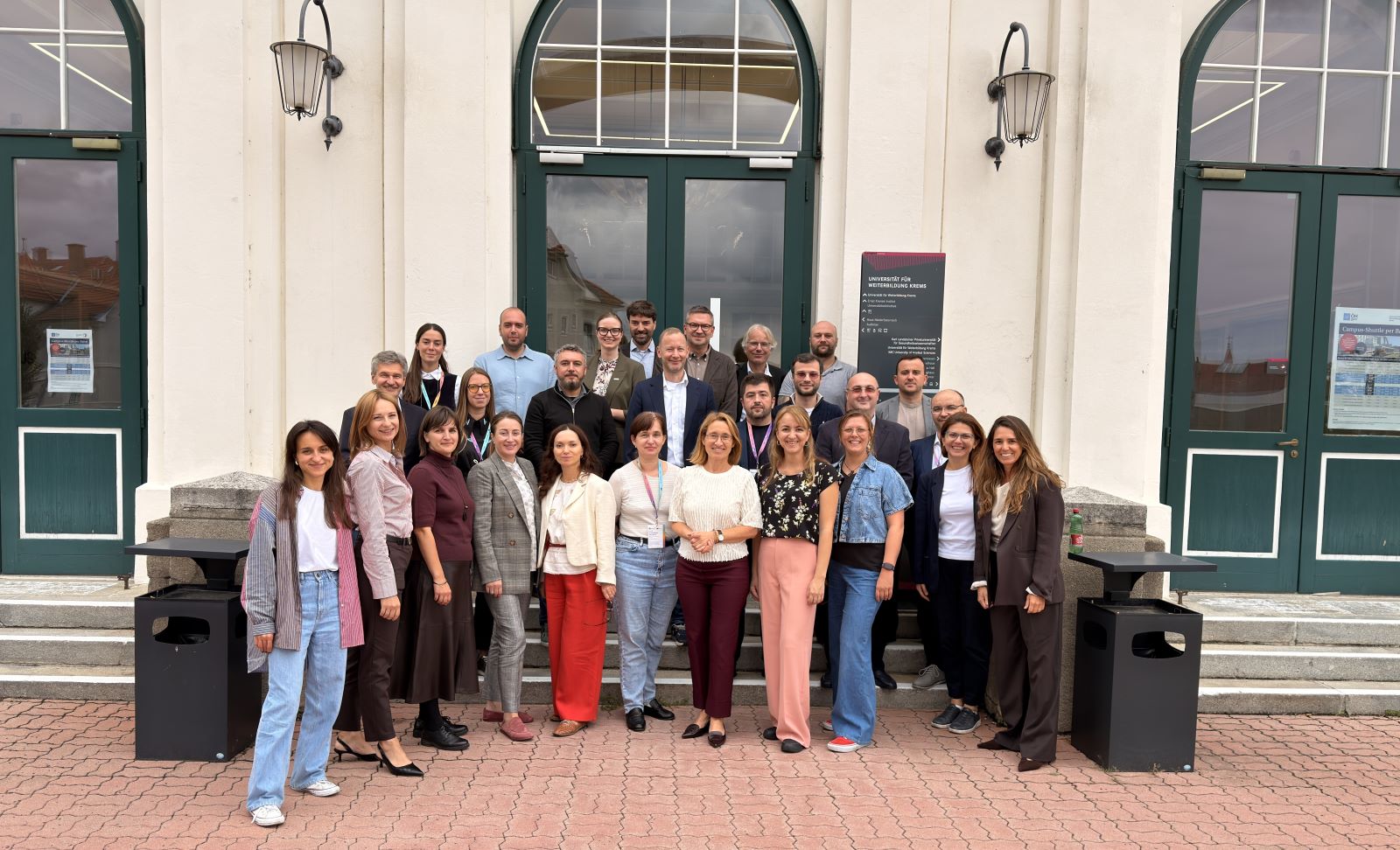
Participants of the EaP Study Visit gathering in front of the University's Old Building
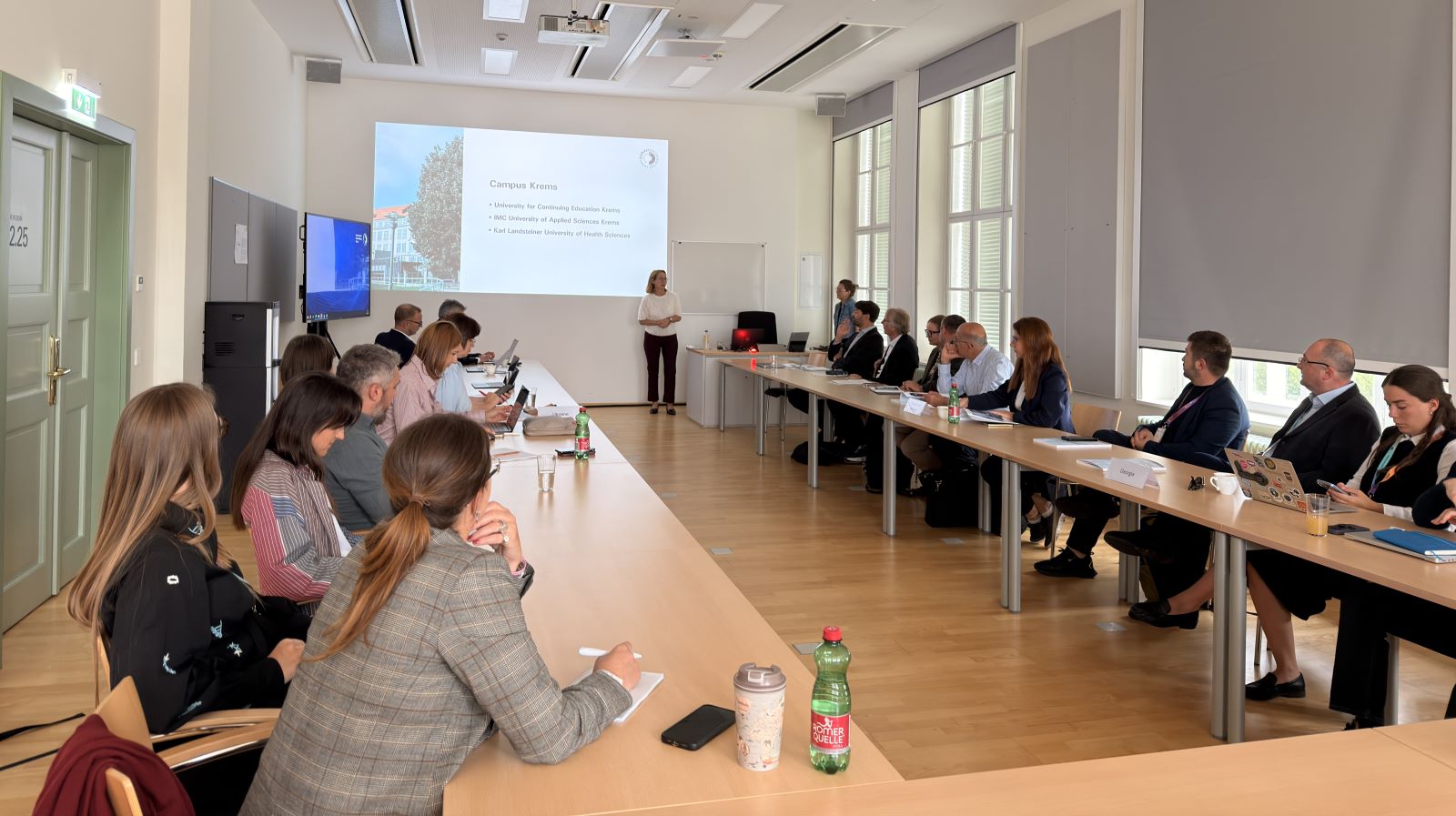
Rector Weber and the participants of the EaP Study Visit during joint workshop in the seminar room
As part of the program, Rector Viktoria Weber presented the University’s strategic initiatives for science-business collaboration. The Service Center for Research Support and Transfer provided insights into regional cooperation structures. The delegation also learned how the university supports researchers in developing and implementing Horizon Europe projects.
The university’s strategic focus is also reflected in its performance in European research funding. For the second consecutive year, the University for Continuing Education Krems has ranked fifth among Austrian universities in terms of EU funding volume per 100 researchers. (FFG EU-PM 2026)
Selected projects as a starting point for new collaborations
Several specific projects illustrated how science-business collaboration works in practice. The presentations focused on experience from the EU-funded projects AISHA, DIGIMPACT.EU and AI4Gov, all of which are based at the Department of e-Governance and Administration. The projects Greene and MammoS from the Center for Modelling and Simulation were also presented, as was the project BEETHOVEN from the Research Lab for Aquatic Ecosystem Research and -Health and its collaboration within EIT Water. In addition, the FFG-COMET-funded project PI-SENS, coordinated by Danube Private University (DPU) and involving UWK as a project partner, was presented. Participants also gained insights into managing international science-business consortia through the Erasmus+ Blueprint project BrightSkills.
The exchange was designed to do more than showcase ongoing projects. Together with the delegates, participants discussed potential avenues for future collaborations and European research projects.
Further information on the projects
- The Artificial Intelligence Skills Hub Academy (AISHA) aims to establish a central AI Skills Academy focusing on generative AI and advanced AI skills.
- The project Digital transformation for university-born, high-impact innovation and entrepreneurship (DIGIMPACT.EU) aims to support universities across Europe in strengthening their capacities in innovation and entrepreneurship through digital transformation.
- AI4Gov Accelerate explores how AI can improve policymaking while safeguarding democratic values.
- The project MaMMoS (Magnetic Multiscale Modelling Suite) aims to advance the computational development of magnetic materials by bringing together different simulation methods in a shared software solution for research and industry.
- Linking Brain, Environment and Ecosystems Through Holistic Omics and Validated Evidence-based Nutrition guidelines (BEETHOVEN) is a project that aims to elucidate the relationships between food groups, beverages, macro- and micronutrients, and mental disorders.
- The project Personalized Medicine Enabled by Intelligent Sensing Systems (PI SENS) will provide essential know-how for innovative technologies to establish a personalized health and prevention system.
Contact


Tags

