On October 2, 2026, the University for Continuing Education Krems held its first Dies Academicus, an academic celebration honoring achievements across the University. In the Audimax on Campus Krems, five PhD graduates from the PhD programs in Regenerative Medicine and Migration Studies received their certificates. Four newly habilitated scholars and three ERC grant recipients were also honored. The keynote address was delivered by Prof. em. Dr. Dr. h.c. Antonio Loprieno, former long-serving president of the Swiss Rectors’ Conference Swissuniversities and the Austrian Science Council.
“At today’s Dies Academicus, we are celebrating our own academic day of celebration for the first time – a day that is to have a special place in the university year in the future,” Rector Univ.-Prof. Dr. Viktoria Weber said in her opening remarks. The day is intended to honor the achievements of members of the University and bring together employees from all areas. “What began more than 30 years ago as an innovation in education policy is today an internationally recognized university model.” The University’s particular strength, she said, lies in combining research and teaching with professional practice. More than 32,000 graduates have taken scientific knowledge directly into business, public administration, health care, culture, and civil society.
Weber sees current developments in artificial intelligence primarily as an opportunity for research and teaching. The easier it becomes to generate content, the more important subject-specific contextualization and the scientific context become. At the same time, personal, dialog-based learning is gaining importance, and the University’s student-to-faculty ratio and its campus as a place for interaction provide favorable conditions for this. Looking to the future, the Rector articulated a clear aspiration: “Universities of the future must set the agenda, they must make use of opportunities, and they must make an impact.” For the University for Continuing Education Krems, this means above all continuing to confidently build on its leadership in academic continuing education.
New responsibilities for Universities
Keynote speaker Antonio Loprieno placed the first Dies Academicus in the context of the history of European universities. He counts the University for Continuing Education Krems among the new universities established after 1989 that did not primarily conceive of higher education institutions as platforms for academic diversity, but as institutions embedded in a specific ecosystem. It is a particularly strong example of a university with a distinctive profile.
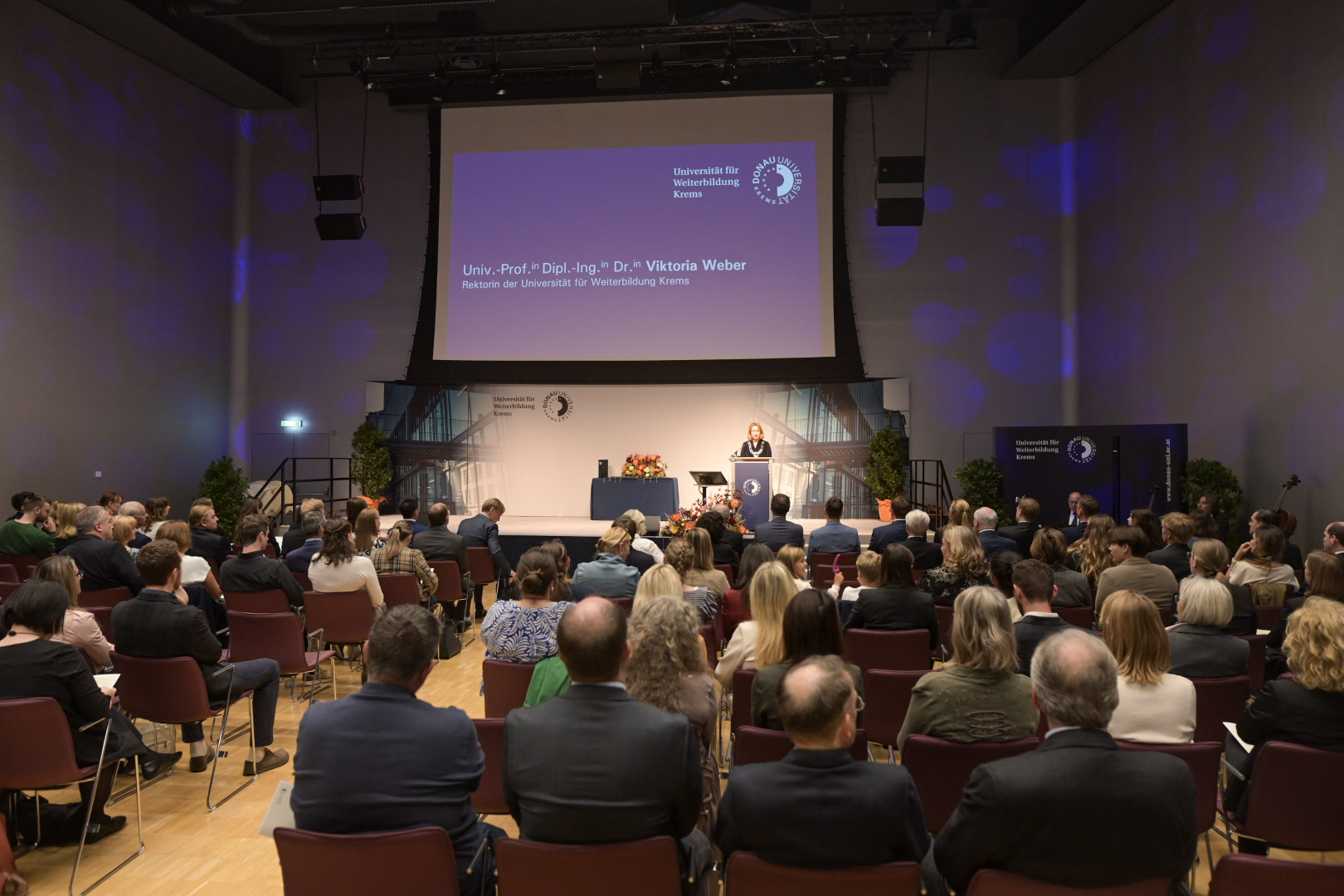
Rector Viktoria Weber opened the first Dies Academicus of the University for Continuing Education Krems in the Audimax on Campus Krems.
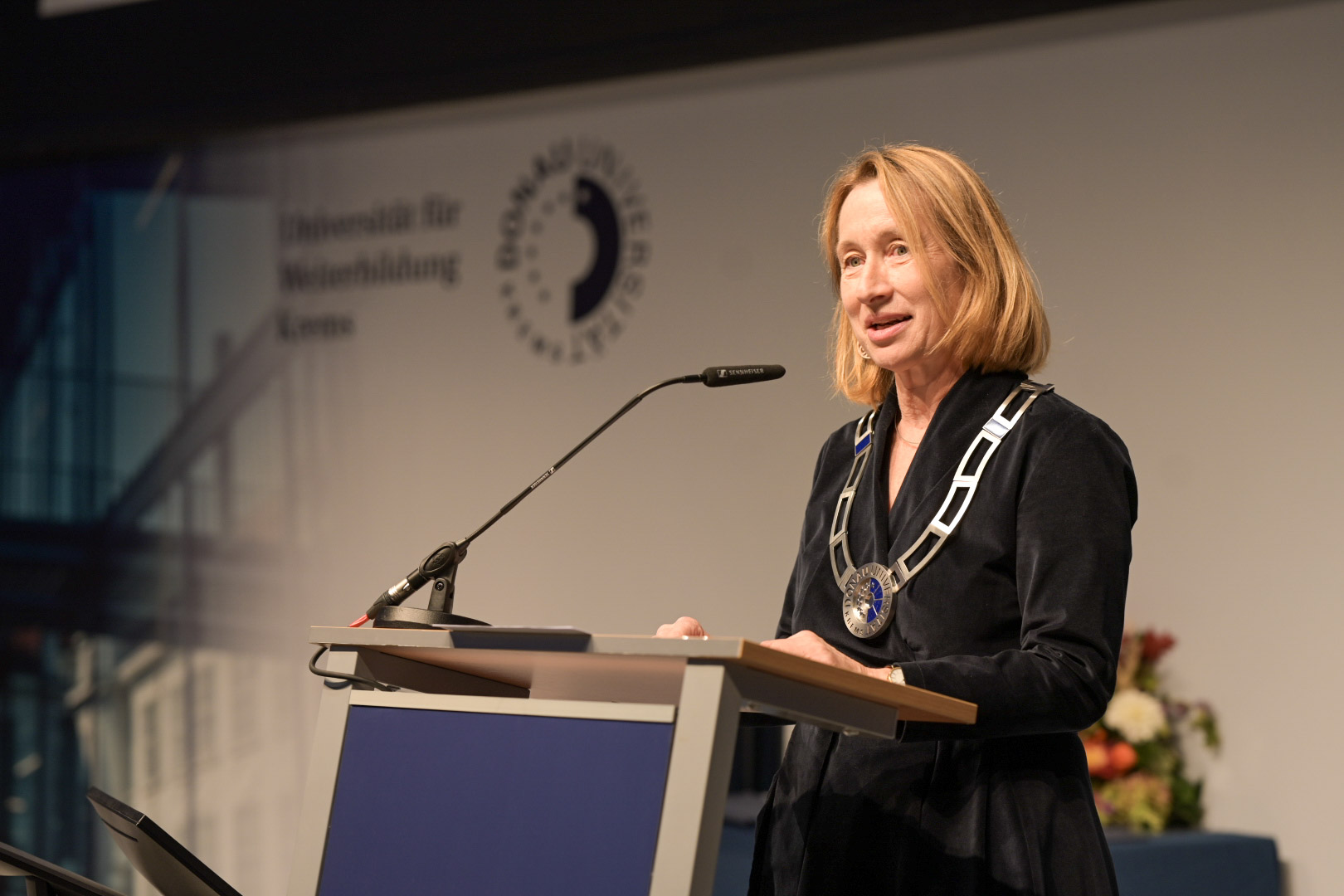
In her welcoming remarks, Rector Viktoria Weber reflected on the university’s history and looked ahead to future challenges.
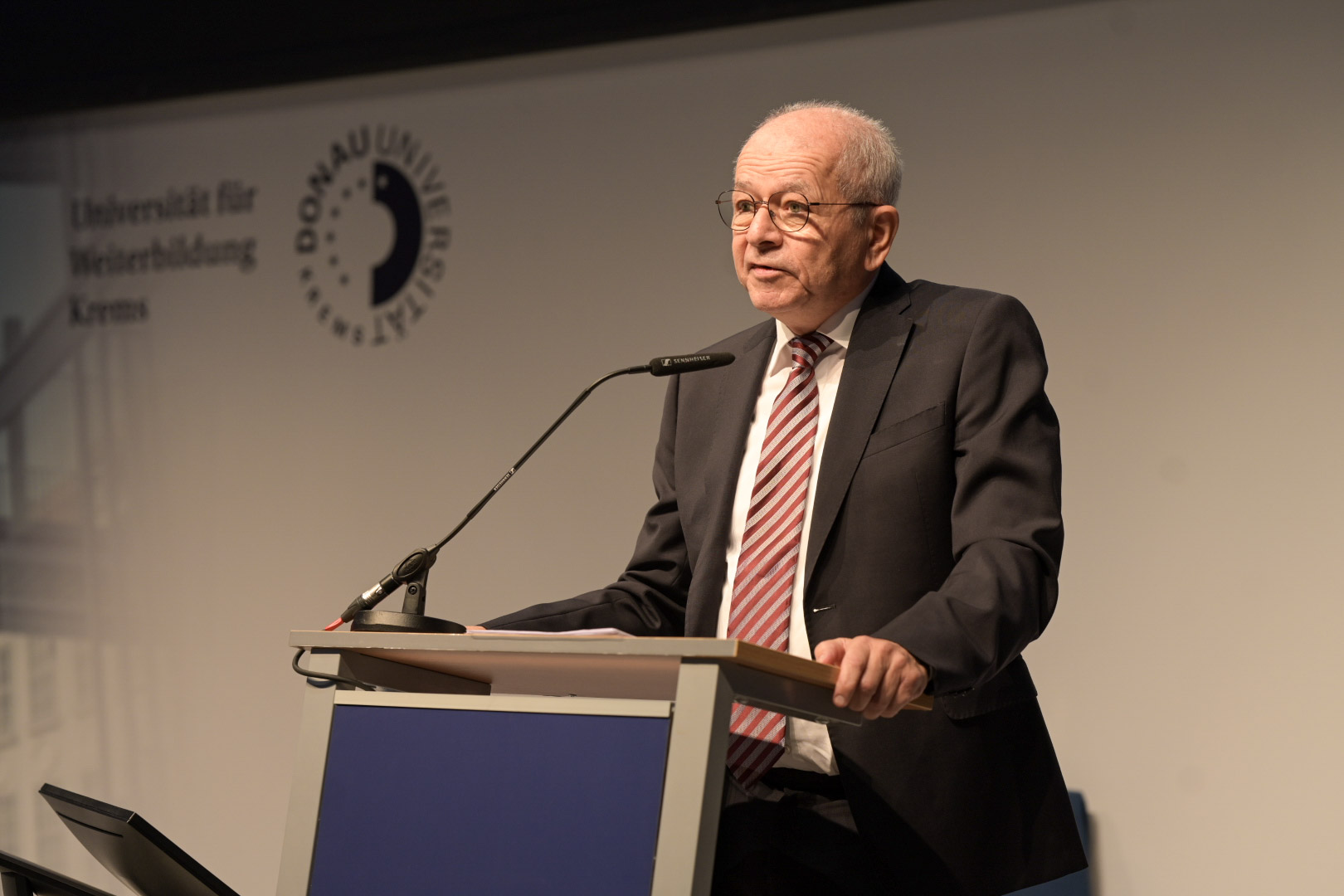
Keynote speaker Antonio Loprieno placed the University for Continuing Education Krems within the context of the development of the European higher education landscape.
Loprieno described generative AI as the greatest upheaval in academic life since the invention of the printing press. The challenge, he said, is to develop quality-assurance procedures for algorithmically generated knowledge comparable to those developed for printed knowledge over the past 500 years. The University for Continuing Education Krems is well on its way to doing so. “In the future, the university will not primarily impart knowledge, but manage and also tame the flood of existing knowledge,” Loprieno said. A key factor in the University’s further development will also be the expansion of its symbolic capital.
Because basic research continues to be held in higher regard by society than its application, he said, it is also important to further expand and intensify the successful research conducted in Krems. The recognition of the ERC grant recipients shows that this is already becoming visible.
According to Loprieno, universities face different questions regarding internationalization today than they did ten years ago. Geopolitical upheavals have shaken confidence in the Anglo-Saxon model, and established international ties can become a security risk. “We now associate America more with restrictions on academic freedom than with large-scale institutional collaboration.” Universities are therefore once again placing greater emphasis on cooperation with neighboring regions. Austrian universities, and the University for Continuing Education Krems in particular, have a unique advantage through their ties with Central and Southeastern Europe, he said, and should continue to build on it.
Doctoral Degrees, Habilitations, and ERC Grants
Univ.-Prof. Dr. Stefan Nehrer, MSc, Dean of the Faculty of Health and Medicine, introduced the four graduates of the PhD program in Regenerative Medicine: Kenneth Chen, Denisa Roxana Cont, Jennifer Fritz, and Rosa Maria Nothnagel. Zina Lizanne Fabienne Weisner received her PhD in Migration Studies and was introduced by Univ.-Prof. Dr. Barbara Brenner, Dean of the Faculty of Business and Globalisation.
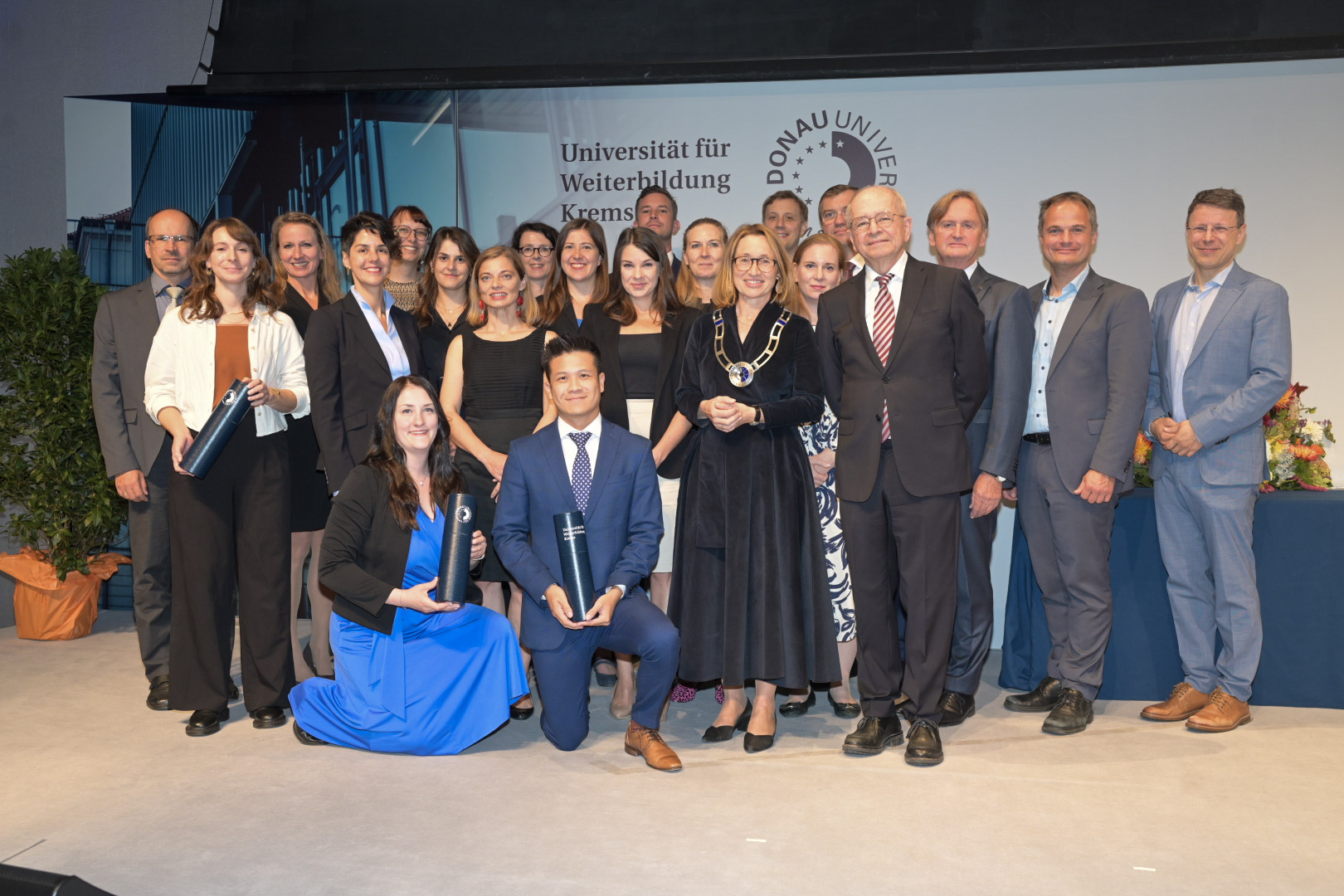
Group photo from the 2026 Dies Academicus at the University for Continuing Education Krems (from left to right): Jens Hartmann, Zina Lizanne Fabienne Weisner, Dean Barbara Brenner, Julia Teixeira Mourao Permoser, Heidrun Bohnet, Rosa Maria Nothnagel (kneeling), Denisa Roxana Cont, Lea Müller-Funk, Dean Eva-Maria Stöckler, Kenneth Chen (kneeling), Jennifer Fritz, Liliya Satalkina, Christoph Stotter, Noella Edelmann, President Viktoria Weber, Markus Neubauer, Andrea de Luna, Senate Chair Clemens Appl, keynote speaker Antonio Loprieno, Dean Stefan Nehrer, Vice Rector Stefan Oppl, Vice Rector Daniel Varro.
Chair of the Senate Univ.-Prof. Ing. Dr. Clemens Appl, LL.M., honored four newly habilitated scholars. Noella Edelmann completed her habilitation in Digital Governance of Public Sector Organizations, while Liliya Satalkina habilitated in Innovation Systems. Markus Neubauer and Christoph Stotter both focused on the knee joint: Neubauer, among other things, on stem cells from the knee’s adipose tissue for cartilage formation, and Stotter on modern knee surgery techniques, including AI-assisted measurement of full-leg X-rays. At a university whose students come from professional practice, it is only natural to conduct research in, with, and for practice, Appl emphasized.
Three female researchers in migration studies who have secured highly prestigious grants from the European Research Council were also honored. Assoz. Prof. Dr. Heidrun Bohnet investigates whether relations between groups of refugees in North Africa are developing more toward solidarity or rivalry. Assoz. Prof. Dr. Lea Müller-Funk researches how refugees perceive the state on theirl journeys and how this affects their political participation. Univ.-Prof. Dr. Julia Teixeira Mourão Permoser, MA BS, focuses on the ethical dilemmas of migrant solidarity. Just two days earlier, she had been awarded the Lower Austria Science Prize.
Faculty dialogue looks to the future
The event concluded with a discussion among the three faculty leadership teams on the role of the University in the years ahead. Barbara Brenner emphasized that students in leadership positions can find knowledge everywhere, but look to the University for orientation and space for reflection. Mag. Dr. Eva Maria Stöckler, MA-ME, Dean of the Faculty of Education, Arts and Architecture, sees one of the University’s key responsibilities as strengthening trust in scientific findings. For Stefan Nehrer, medicine remains, despite the importance of AI, a deeply personal engagement with people – the currency of the future will not be Bitcoin, but education.
Contact


Tags

