How can freedom of expression be safeguarded in times of increasing societal polarization? This question was at the center of the lecture “Freedom of Speech in a Polarized Era” by Professor Carson Holloway, hosted by the University for Continuing Education Krems in cooperation with the U.S. Embassy in Austria. The event brought together students, researchers, and interested members of the public and provided a forum for a nuanced discussion of a fundamental right in democratic societies.
Drawing on political-philosophical and constitutional principles, Holloway traced the development of freedom of expression, particularly in the U.S. context. Central to his argument was the observation that political polarization is increasingly straining how societies deal with free speech: when societal conflicts are no longer perceived primarily as differences of opinion over means, but as disputes over fundamental values, the willingness to tolerate divergent positions comes under pressure.
Another focus of the lecture concerned the effects of technological change. According to Holloway, social media are blurring the traditional boundaries between private speech and public communication. Statements that would previously have remained within a limited circle can now achieve global reach—with corresponding consequences for public debate, political decision-making, and regulatory frameworks. This development further intensifies existing tensions between protecting freedom of expression and preventing societal harm.
Between legal tradition and societal responsibility
Holloway also highlighted differences and similarities between European and U.S. approaches to freedom of expression. While U.S. law – particularly through the jurisprudence of the Supreme Court – affords very broad protection even to provocative or offensive speech, European legal systems are more strongly shaped by the idea of limiting freedom of expression in the interest of the common good. Historically, Holloway argued, these positions are less far apart than current debates might suggest.
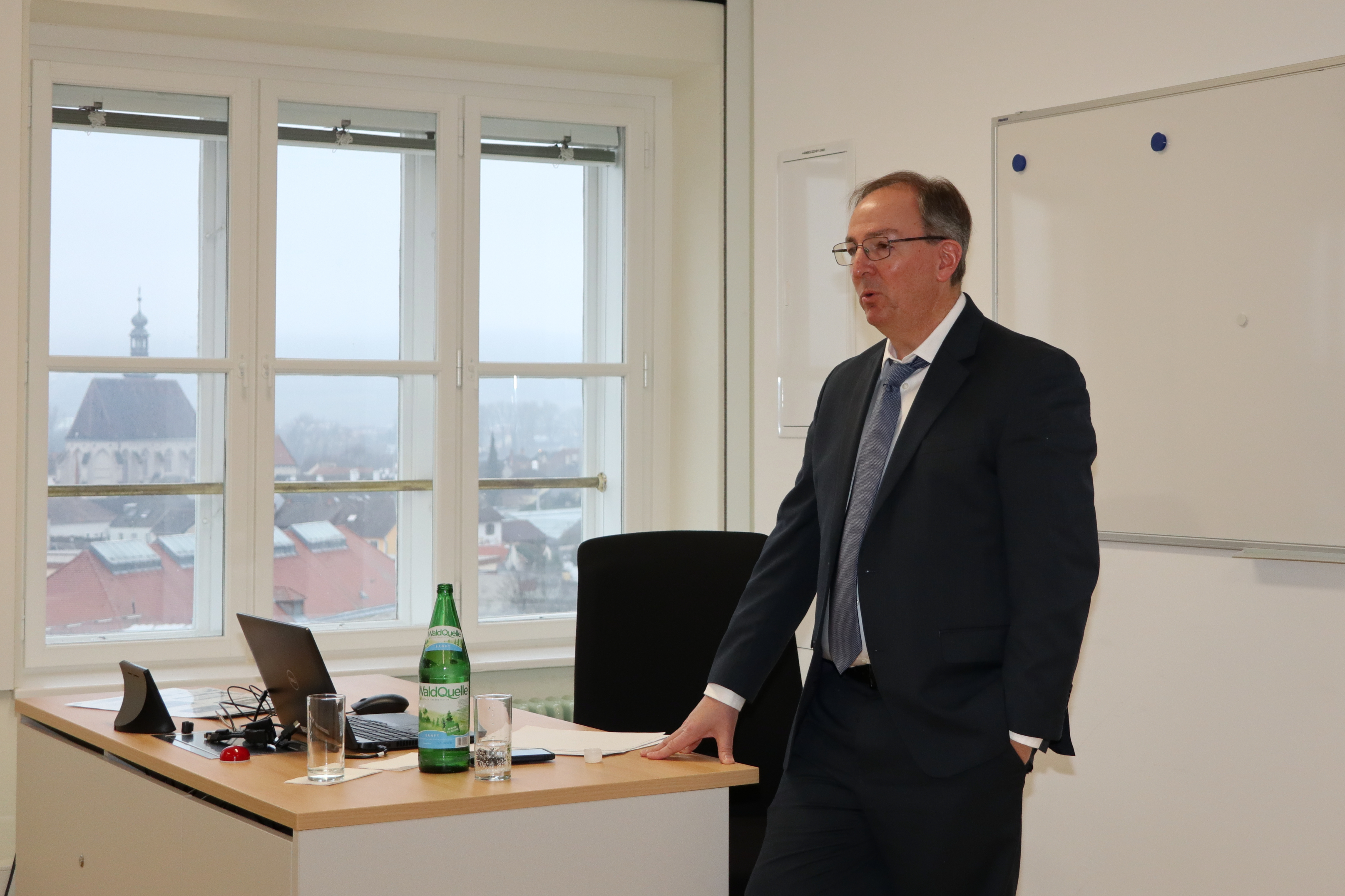
Professor Holloway visits Krems: In his lecture, he addressed the question of how freedom of expression can be safeguarded in times of increasing societal polarization.
The subsequent discussion with the audience made clear that freedom of expression is not only a legal issue, but also a cultural and societal one. Topics such as social sanctions, public morality, academic freedom, and the role of political institutions demonstrated that the tension between freedom and responsibility has become more complex and challenging than ever. The event also underscored the importance of open, reasoned debate – particularly in polarized times.
About the speaker
Carson Holloway is Professor of Political Science at the University of Nebraska at Omaha, where he has taught since 2002. He studied political science at the University of Northern Iowa and received his doctorate from Northern Illinois University in 1998.
Holloway has served as a visiting scholar at several renowned U.S. institutions. In 2005/06, he was a William E. Simon Visiting Fellow at Princeton University, and in 2014/15 he was a Visiting Fellow at the B. Kenneth Simon Center for Principles and Politics at the Heritage Foundation in Washington, D.C.




Tags

