At a time marked by uncertainty, polarization, and increasing pressure on academic institutions, the eighth Research Summit at the University for Continuing Education Krems focused on the role of conflict competence in higher education. The evening brought together researchers, practitioners, and policymakers to discuss how universities can view conflict as an opportunity for learning and institutional development.
Conflict is an inevitable part of everyday life, and higher education is no exception. In a world shaped by multiple crises and growing societal tensions, the ability to address conflict constructively is essential. At this year's Research Summit, the Department for Higher Education Research addressed this pressing topic during a public event held on November 18, 2025, at the University for Continuing Education Krems. Chaired by Attila Pausits, the head of the department, the event marked the official launch of the new Certificate Program "Managing Conflict and Effective Dispute Resolution in Higher Education" and continued the discussion of the previous workshop with a focus on conflict as a driver of institutional learning and the costs of unresolved conflict.
From Tension to Transformation
In her keynote address, “From Tension to Transformation: Rethinking Conflict in Higher Education”, Jean Grier, President of the European Network of Ombuds in Higher Education (ENOHE), reframed conflict not as a failure but as a potential driver of institutional learning and development. Universities encounter friction where diverse roles, expectations, and responsibilities converge. Grier emphasized that unresolved tensions – often hidden within complex academic structures – can have significant emotional and financial consequences. To counter this, universities need a more transparent and proactive culture of conflict engagement, supported by professional ombuds services.

Jean Grier, President of the European Network of Ombuds in Higher Education (ENOHE), delivered the keynote lecture on the topic “From Tension to Transformation: Rethinking Conflict in Higher Education.”
Leadership and Policy Approaches to Conflict
The panel discussion, “The Costs of Conflict – Understanding the Impact of Unresolved Disputes in Higher Education,” brought together distinguished voices from HE leadership, student representation, and international ombudsperson practice. Rector Viktoria Weber highlighted rising pressures both within the university and across academia at large, emphasizing the need for stronger cohesion and shared perspectives across academic units. Padmakumar Nair, Vice Chancellor of the Thapar Institute of Engineering and Technology (India), underscored the central role of empathy in conflict engagement. Calling “empathy the mother of excellence,” he advocated for what he termed “compassionate reframing” when addressing disputes.
Student Perspectives and Ombuds Expertise
Maximilian Veichtlbauer, Chair of the Students’ Union at the University of Krems, illustrated the wide spectrum of issues that student representatives must navigate and noted the importance of regular exchange with fellow representatives. Anna-Katharina Rothwangl, Head of the Austrian National Student Ombuds Office, highlighted recurring challenges in supervision and assessment processes, which frequently escalate into conflicts when institutional mechanisms fall short. Jean Grier, President of the European Network of Ombuds in Higher Education (ENOHE), observed a marked trend: students today are more willing to seek help than in the past. When asked how she herself learned “the art of the ombuds,” she pointed to on-the-job experience, since no systematic training opportunities existed when she entered the profession. Her remarks underscored the current need for structured qualification pathways – such as the newly launched Certificate Program Managing Conflict and Effective Dispute Resolution in Higher Education.
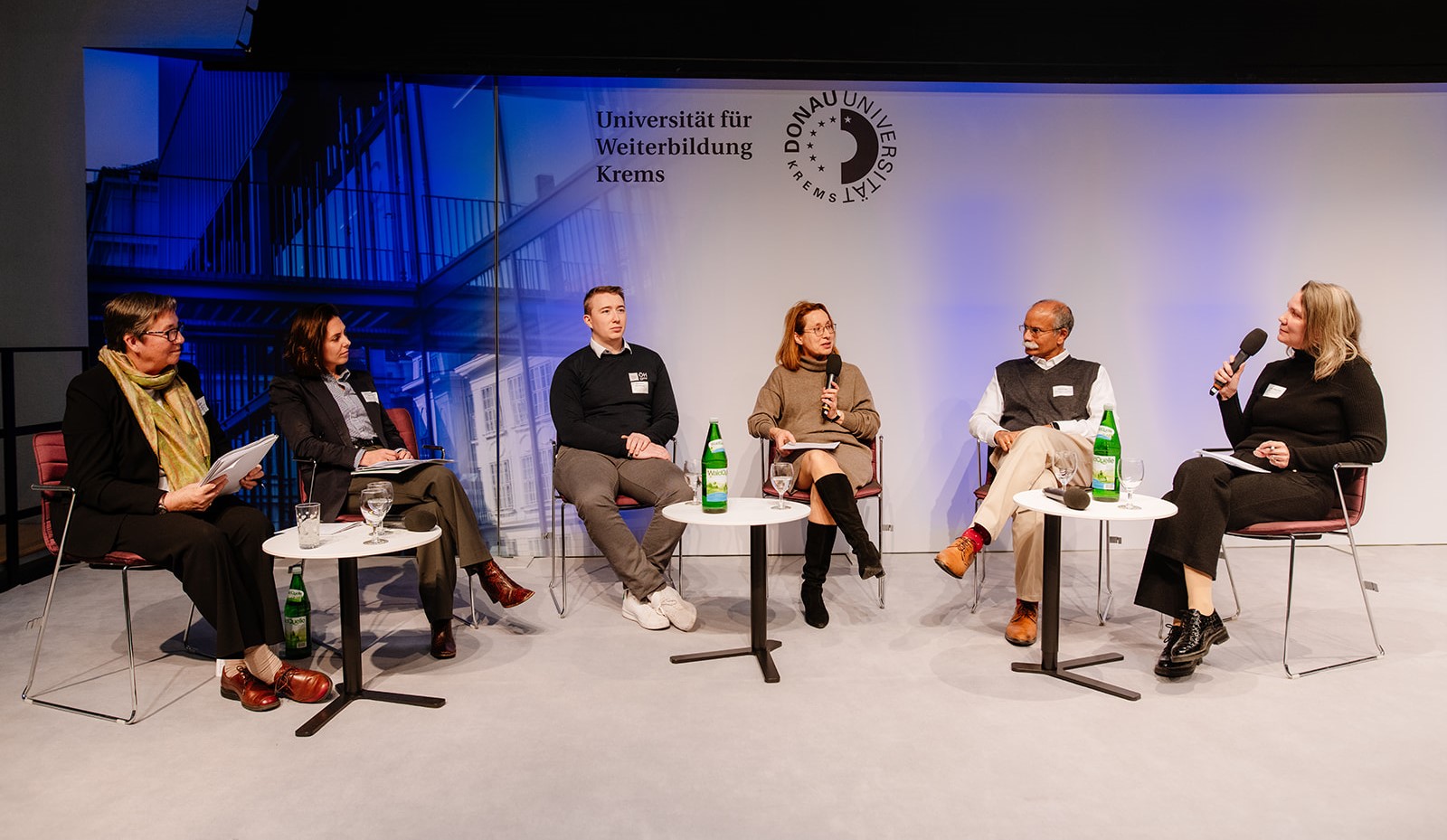
Panel discussion, participants: Jean Grier, President of the European Network of Ombuds in Higher Education (ENOHE); Anna-Katharina Rothwangl, Head of the Student Ombuds Office of the Federal Ministry for Women, Science and Research; Maximilian Veichtlbauer, Chair of the Austrian National Union of Students at the University for Continuing Education Krems; Viktoria Weber, Rector of the University for Continuing Education Krems; Padmakumar Nair, Vice Chancellor, Thapar Institute of Engineering and Technology, India; Moderator: Elke Welp-Park.
Addressing a Societal Challenge
By examining how higher education institutions handle conflict, the Research Summit also addressed a broader societal responsibility. Conflict competence is needed across all areas of society, particularly in times of uncertainty and disruption. Through ongoing research, professional development, and public dialogue, the University for Continuing Education Krems contributes to meeting this need. The Research Summit of the University for Continuing Education Krems provided a valuable opportunity to make current research visible and to engage in an inspiring exchange with stakeholders from across different sectors.
Contact




Tags

