Permanent magnets are a critical component of electric motors and generators in many applications, the most important of which are wind turbines and hybrid/electric vehicles. The rapid growth of these sectors has resulted in an increased demand for high performance Nd-Fe-B-based permanent magnets but the long-term sustainability of using global resources of rare earth elements like Nd and Dy at this high rate is questionable. There is a clear need to develop a rare-earth-free permanent magnet. A digital twin is a set of information which fully describes the structure and properties of a physical object. This is highly challenging as the magnetic state of a material depends not only on its physical structure and magnetic properties but also on its magnetic and thermal history. The digital twin of a permanent magnet has the potential to play a vital role in the development of novel permanent magnets, and in real-time monitoring of the performance of magnets in applications. Obtaining the digital twin of a permanent magnet would therefore deliver important contributions to the digitalisation of materials science, environmental sustainability, clean energy and electromobility. In this project the rare-earth-free magnet, MnAl-C, will be taken as a model system and an enhanced micromagnetic model will be developed. Advanced characterisation combined with magnetic measurements and domain images will form the basis for the simulations. A machine learning model will then be developed and data assimilation will be employed in order to reduce the offset between predicted and measured magnetic properties. The trained model represents the microscale component of the digital twin of a MnAl-C permanent magnet.
News
Demagnetization process at the interface between an antiphase boundary and a true twin boundary. The results regarding nucleation will be published shortly.
The Special Semester on Computational Methods for Electric Machines will be held at the Johann Radon Institute for Computational and Applied Mathematics (RICAM) from October 6 to December 12, 2025. A workshop on Magnetic Material Modelling is taking place from November 24 to 28. Dario Arifović and Markus Gusenbauer are contributing with the work entitled: “Feature engineering for twin boundary analysis in MnAl-C”.
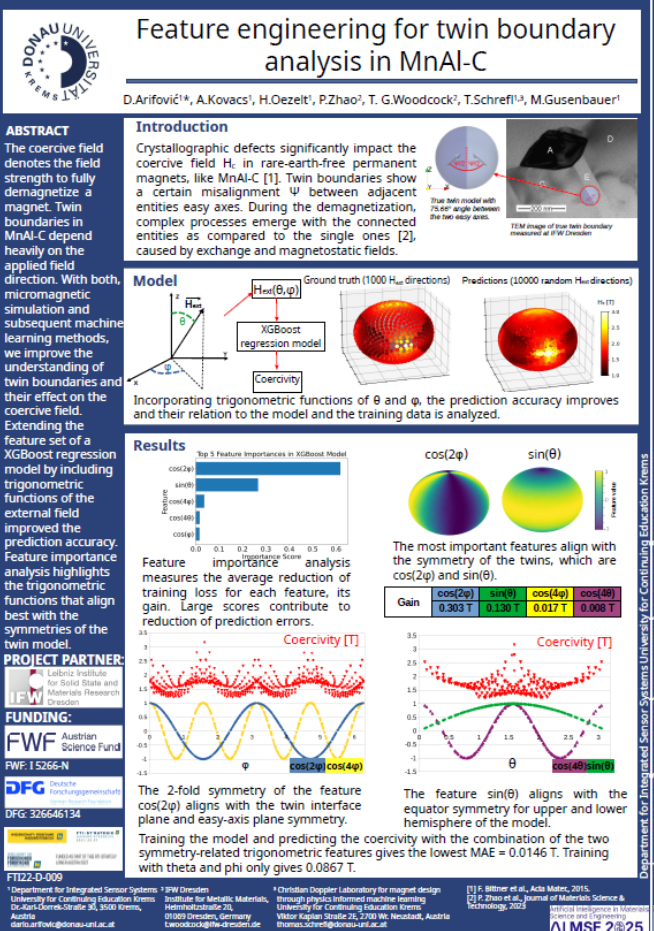
The 2nd Conference on Artificial Intelligence in Materials Science and Engineering (AI MSE 2025) is taking place from 18 to 19 November 2025 in Bochum. Dario Arifović is contributing with a poster entitled: “Feature engineering for twin boundary analysis in MnAl-C”. The poster is presented on the virtual conference platform as well as on-site with an additional poster pitch presentation.
The Joint European Magnetic Symposia (JEMS2025) took place in Frankfurt from August 24 to 29. Researchers from around the world presented their latest findings. We gave two presentations at the conference.
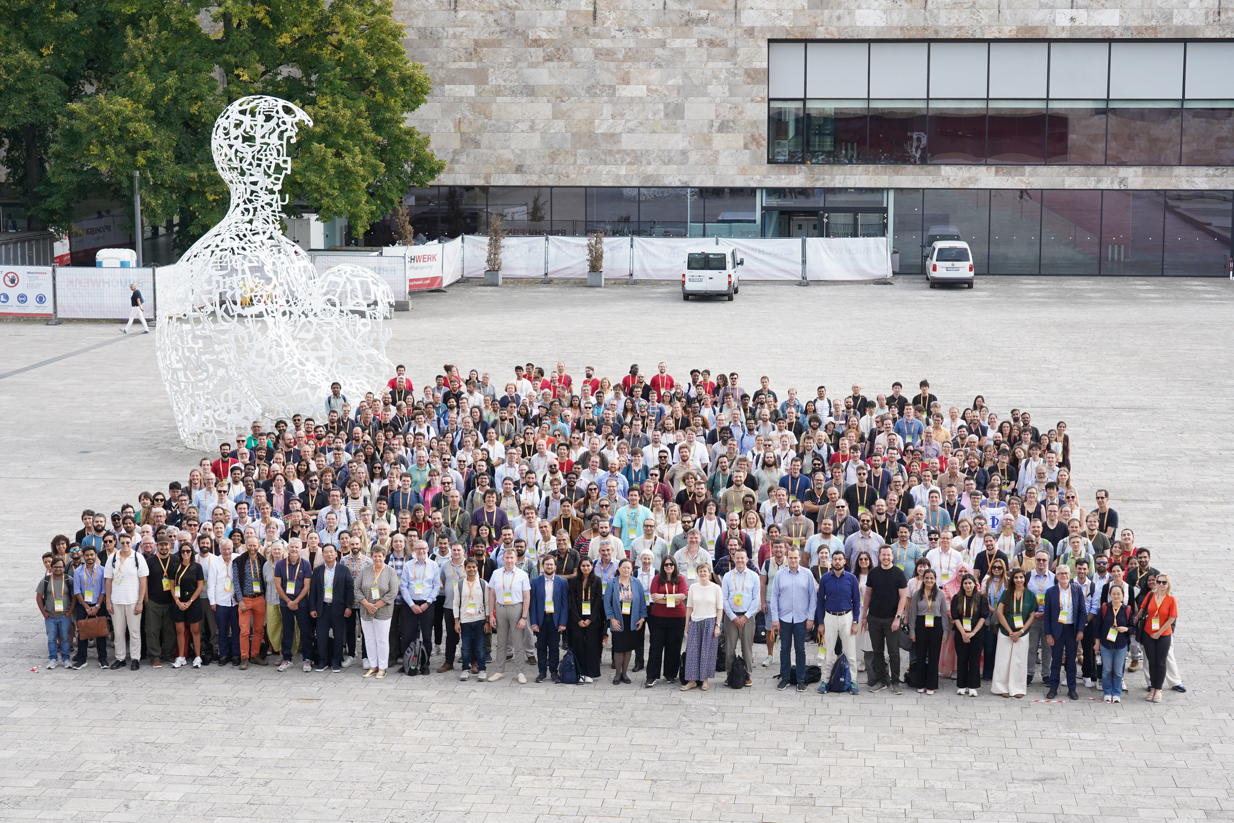
Dario Arifović gave a talk with the title “Feature importance and relation to defect symmetry in MnAl-C” and Markus Gusenbauer presented “Micromagnetic simulations of demagnetization processes at intersecting antiphase and true twin boundary in MnAl-C”.
In 2025 we will show our research results at several conferences. We submitted 2 abstracts to the Joint European Magnetic Symposia (JEMS) 2025, which will be held in Frankfurt from August 24 to 29. Dario Arifović will contribute with the work: “Feature importance and relation to defect symmetry in MnAl-C” and Markus Gusenbauer will talk about “Micromagnetic simulations of demagnetization processes at intersecting antiphase and true twin boundary in MnAl-C”. From November 18 to 19 we will contribute at the Conference on Artificial Intelligence in Materials Science and Engineering (AI MSE 2025) in Bochum. The work with the title: “Feature engineering for twin boundary analysis in MnAl-C” will be presented by Dario Arifović.
Stefan Stanciu is presenting the work on “Machine Learning assisted interface analysis in MnAl-C” at the Materials Science and Engineering Congress 2024 (MSE2024), which is held in Darmstadt from 24th to 26th September, 2024. In this study, we leverage a comprehensive database comprising results from numerous simulation runs across a variety of crystallographic twin scenarios. Our findings indicate that unless the dataset dimension is reduced to less than 10% of the original size, there is no significant deviation in the output. This means, that it is possible to investigate only a few external field directions with respect to the twin boundary interface, to obtain a full description of the coercive field distribution of particular twin interfaces. For more details click to see the full abstract .
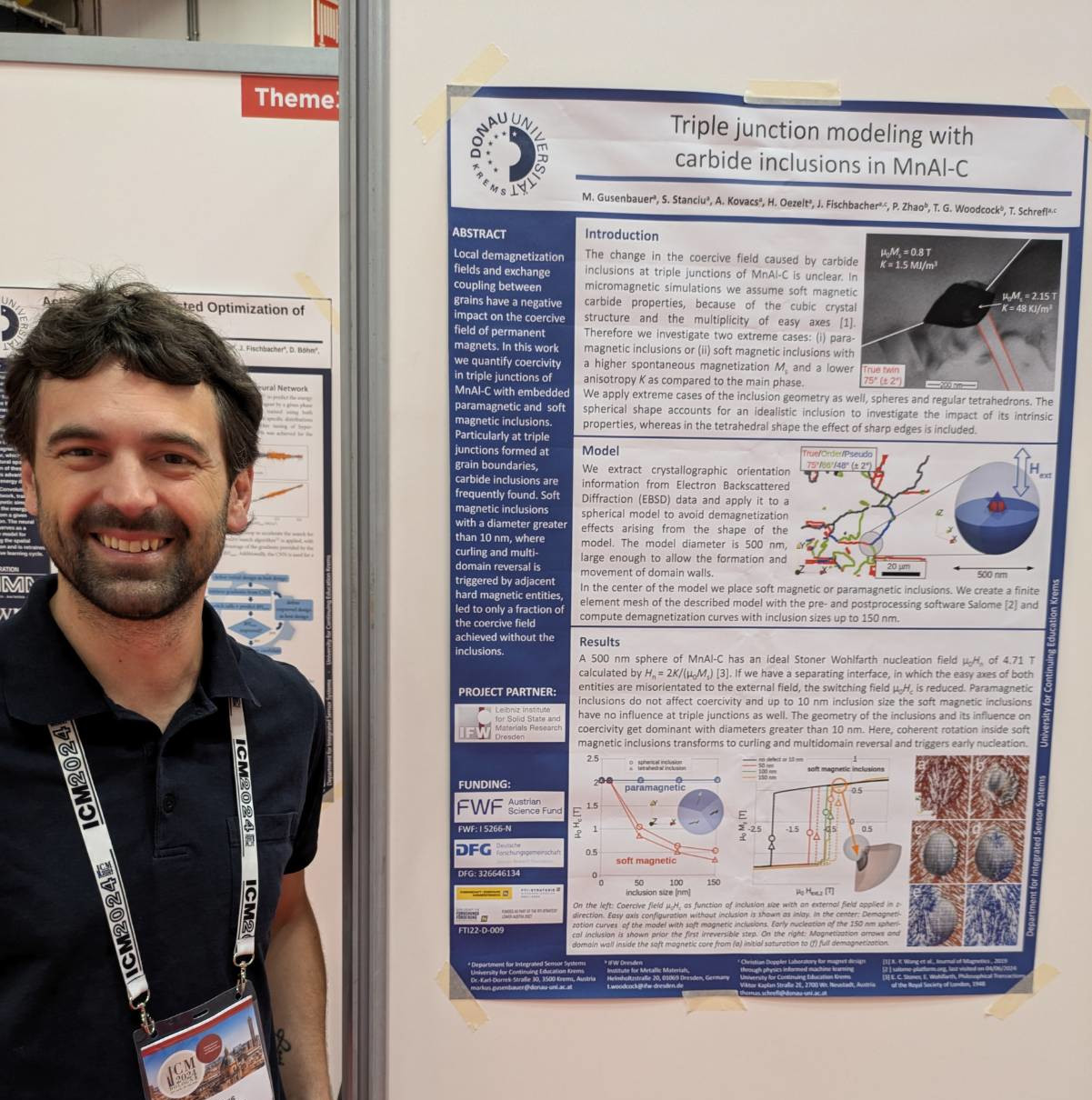
Our recent research has been submitted to the Journal of Magnetism and Magnetic Materials with the title: “Micromagnetic study of grain junctions in MnAl-C containing intergranular inclusions”. In this work we quantified coercivity in single and multigrain systems of MnAl-C with embedded paramagnetic and soft magnetic inclusions. On the 3rd of July we presented the work (Link: poster_ICM_gusenbauer.pdf) at the International Conference on Magnetism 2024 (ICM2024) in Bologna.
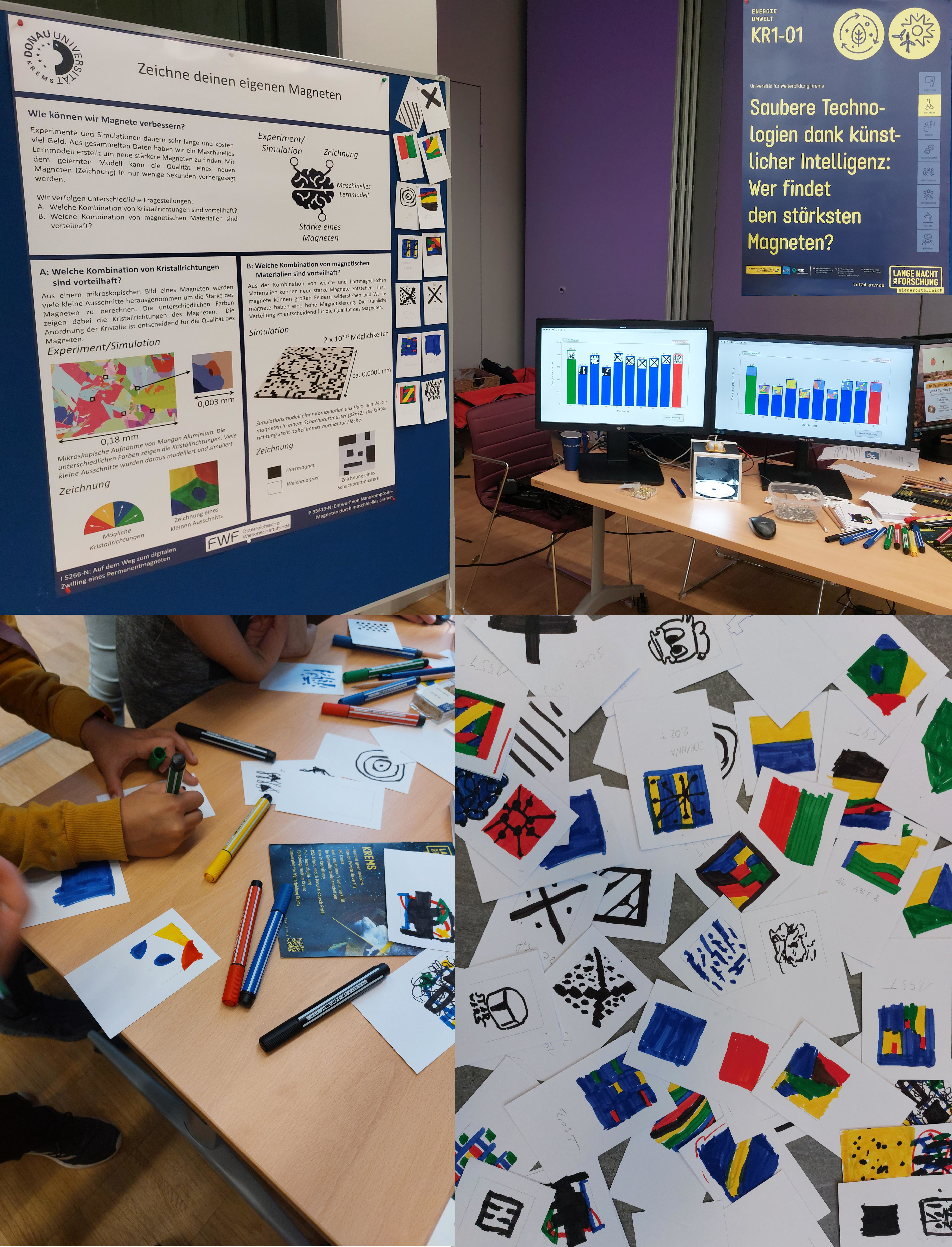
On May 24, 2024 from 17:00 to 23:00, the Long Night of Research took place throughout Austria. At the University for Continuing Education Krems we were represented with the topic: "Clean technologies thanks to artificial intelligence: Who can find the strongest magnet?". The guests were able to actively participate in the research by drawing different phase distributions and crystal structures of magnets. A trained AI evaluated the drawings and predicted the performance of the magnets. In the discussion, we were able to demonstrate the necessity of magnetic research in a wide range of topics for a sustainable and climate-friendly energy transition.
Details
| Duration | 01/02/2024 - 21/07/2027 |
|---|---|
| Funding | Bundesländer (inkl. deren Stiftungen und Einrichtungen) |
| Program |

|
| Department | |
| Principle investigator for the project (University for Continuing Education Krems) | Dipl.-Ing.(FH) Dr. Markus Gusenbauer |

