-

Graduation
Certificate
-

ECTS-Points
6
-

Learning format
-

Duration
3 days, part time
-

Start
Winter semester 2027/28
-

Costs
Tiered as Krems Culture Stacks
-

Language
German or English
-


.jpg "© Daniel Novotny")
Can a story be true and more than just accurate? Stories carry something real from one person to another across time, culture, and experience.
Wendy Coones
Head of Academic Development & Cooperations
WHO THIS IS FOR
You do not need to be a writer to be here. You need to be someone who has lived long enough to have stories worth thinking about, and curious enough to want to think about them seriously. Writers, readers, people who have never written anything but have wanted to — all equally welcome. No academic background required.
"Built for curiosity — no prior background needed."
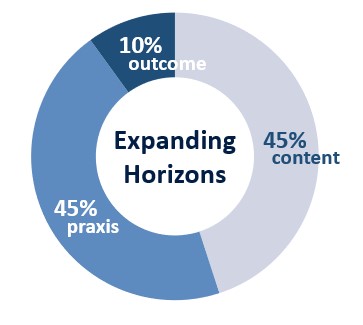
This course is part of the Expanding Horizons category: serious academic engagement without career pressure.
WHAT YOU WILL DO
Participants move between two modes of engagement throughout the course. In the content sessions, you will encounter ideas from across the history and theory of storytelling — not only as an academic exercise, but as material to think and work with. In the lab, you will use that material however fits you: some participants will write; others will read closely and respond; others will experiment with both.
There is a Wachau excursion built into the schedule. Writing in landscape is one of the oldest storytelling traditions there is, and the Wachau has stories layered into it that most people walking through it do not hear. There are group feedback sessions where participants share what they have made or discovered, led by course faculty.
What you walk away with depends on who you are when you arrive — but everyone leaves with something they made, something they begin to read differently, and a set of questions they did not have before (... and perhaps new friends and a new favorite place).
|
|
|
|
When, Where & Formats
Times and Locations
|
what |
when |
where |
|
arrival & kick-off |
thu eve |
heuriger |
|
Modes of Storytelling (Aboriginal to AI) |
fri morn |
campus |
|
Writing in Wachau Nature |
fri aftn |
excursion |
|
Knowledge vs. Stories |
sat morn |
fieldwork |
|
“Tell Me a Story” workshop |
sat aftn |
fieldwork |
|
Storytelling Media & Outlets |
sun morn |
campus |
|
Sharing, Writing & Discussion |
sun aftn |
campus |
|
goodbye & departure |
sun eve |
heuriger |
PARTICIPATION OPTIONS
Every Krems Culture Stacks microcredential is available at three levels. Choose the level that fits your goals — the content is the same for everyone.
OBSERVER — Zuhörer/in
3 credits · 30% of full price
Access the content sessions from the Knowledge Transfer & Storytelling course — lectures and discussions on modes of narrative, from Aboriginal traditions to AI.
You receive: attendance statement. No assessment.
PARTICIPANT — Teilnehmer/in
6 credits · 60% of full price
Full course access: content sessions plus the Arts & Culture Lab, writing experiments, Wachau excursion, and group feedback sessions.
You receive: active participation statement. No assessment.
CREDITING — Kreditierung
9 credits · 100% of full price
Everything in the Participant tier, plus individual faculty feedback on your written work and a formal assessment.
You receive: a certificate with the course name, learning outcomes, and your grade — portable to any institution via standard academic transcript.
Assessment: a reflective written piece (approx. 600–800 words) demonstrating engagement with the course learning outcomes. Individual faculty feedback provided before final submission.
Credit Pathways
Write Your (True) Story
What makes a story true? Storytelling traditions from Aboriginal narrative to AI — and into your own writing. 6 credits · On-site, Campus Krems + Wachau · English
-
Contents
This course builds on theoretical foundations to explore the practical applications of knowledge transfer and storytelling. Students will analyze real-world examples of crossmedia exhibitions, gaining insights into their development as applied research and cultural practice. The course includes a comparative study of various approaches to crossmedia storytelling within the cultural and creative sectors, allowing students to understand the nuances and effectiveness of different methods. This practical focus ensures that students can see how theoretical ideas are implemented, providing valuable insights for creating engaging narratives in museum and exhibition settings.
-
Contents
This collaborative lab environment offers students the invaluable opportunity to immerse themselves in an intensive active learning environment that encourages collaboration. Students work in teams to tackle practical challenges in Arts & Culture under the mentorship of experienced practitioners in dynamic environments. The course emphasizes the development of collaboration and strategy development skills, which are essential in interdisciplinary teams, community arts projects, and roles that require adaptation to diverse perspectives and societal needs. Through hands-on projects and real-world scenarios, students will learn to reflect on teamwork effectiveness and utilize the strengths of each individual member. They will also develop and evaluate strategies that enable the effective integration of Arts & Culture within various sectors, including academia, creative industries, and broader society.
-
Contents
This course offers a structured framework for students to conduct a supervised independent study on a topic of personal interest within Arts and Cultural Studies. Emphasis is placed on methodological soundness, depth of inquiry, and clarity of outcomes, culminating in a reflective presentation. The course supports the development of skills necessary for independent research and reflection, which are beneficial for roles that require self-directed work, such as consultancy, journalism, policy development, entrepreneurship, or any area within the cultural sector where self-guided work is prevalent. Students will engage in the design, negotiation, fulfillment, and presentation of a comprehensive learning contract, ensuring a methodologically sound approach and clear result criteria.
Where can I stack these credits as an elective or embed into a curriculum?
-
Master of Arts (Continuing Education)
Game Studies
8 semesters | 120 ECTS -
Master of Business Administration
MBA
4 semesters | 90 ECTS
Music and Entrepreneurship -
Master of Business Administration
MBA
4 semesters | 90 ECTS
Music Organisations -
Master of Business Administration
MBA Professional
6 semesters | 120 ECTS
Music and Entrepreneurship -
Master of Business Administration
MBA Professional
6 semesters | 120 ECTS
Music Organisations -
Erasmus Mundus Joint Master
Media Arts Cultures (EMJMD)
4 semesters | 120 ECTS -
Erasmus Mundus Joint Master
Media Arts Cultures (EMJMD)
4 semesters | 120 ECTS -
Master of Arts (Continuing Education)
Music Business and Culture
5 semesters | 120 ECTS -
Master of Arts (Continuing Education)
Stage Narration
5 semesters | 90 ECTS -
Academic Expert Program
Stage Narration - Erzählen für die Bühnen unserer Zeit
4 semesters | 60 ECTS
.png)


-Victoria_Nazarova.jpg)
-Ludwig-Drahosch.jpeg)
.jpg "© Daniel Novotny")